
Soil you could scoop up
I'll admit it: the old soil read as cement. A flat disc, a mud photo shrunk about 25 times, darkening all at once when you watered it, under 1,300 identical grey beads. It's gone, and I'm so happy about it.
The pot is now built from each soil's own recipe, akadama, pumice, lava and a little bark, with no bitmap at all. The grains are loose, three shapes per ingredient, at sieve sizes I measured from photos of my own pots (mostly 4 to 8 mm). The akadama and pumice are lumpy, the scoria is jagged with round pores, and the colours come from my own soil, dry and watered. The simulation drives all of it. Each grain dries on its own against the mix's field capacity, water stands on top when you overdo it, moss creeps in with the months since the last repot, and a pot-bound tree's roots show at the rim. The balanced mix is equal parts akadama, pumice and lava with a little bark, which is exactly what I use. It's on main.
Build the base at every repot
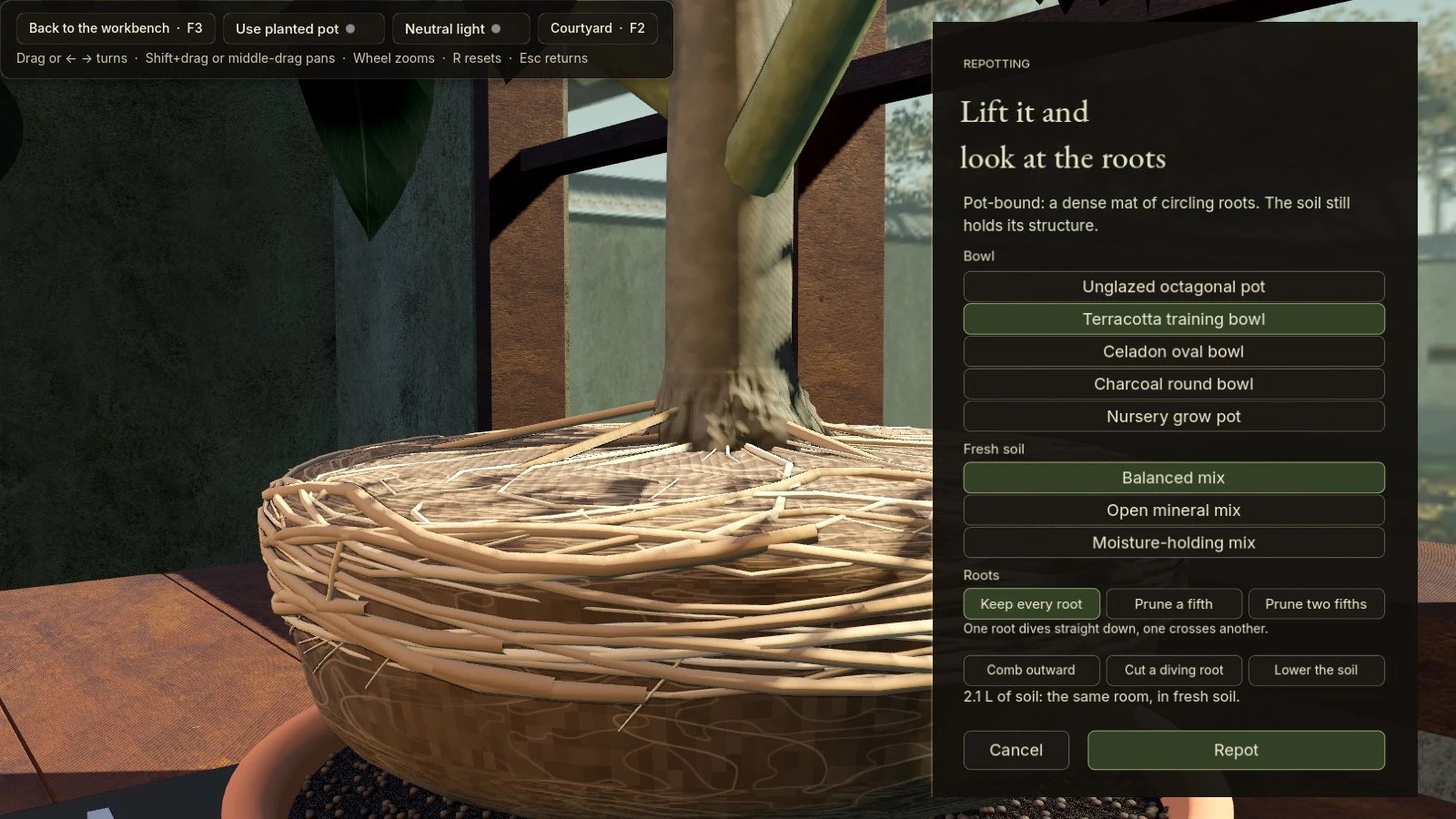
This is the one I've wanted since day one. Every nursery tree now arrives with its own surface roots, and they come with real nursery faults: one or two roots dive straight down, and often one crosses another. Lift the tree at a repot in its season and the root ball tells you what it holds. Then you can cut a diving root, comb the rest outward, and lower the soil once the trunk has thickened.
None of it is drawn on. Cut roots leave the tree's ledgers, and new roots, and the push into the side roots, grow only from the tree's own coarse-root growth. So the base you see is the base you earned. Here's the same ficus after five repots, once left alone and once worked at each repot.
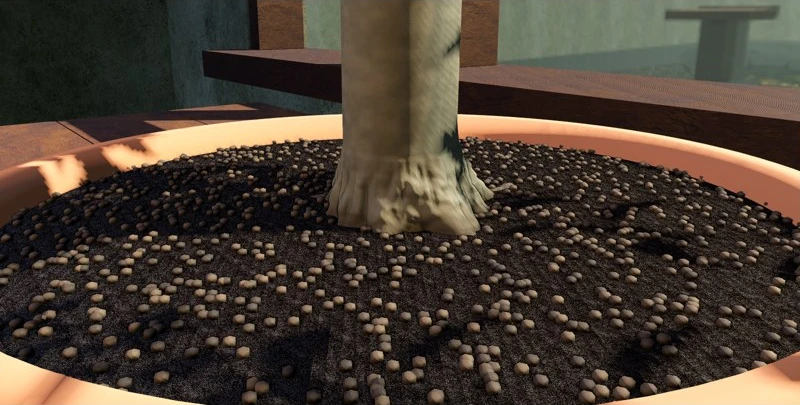
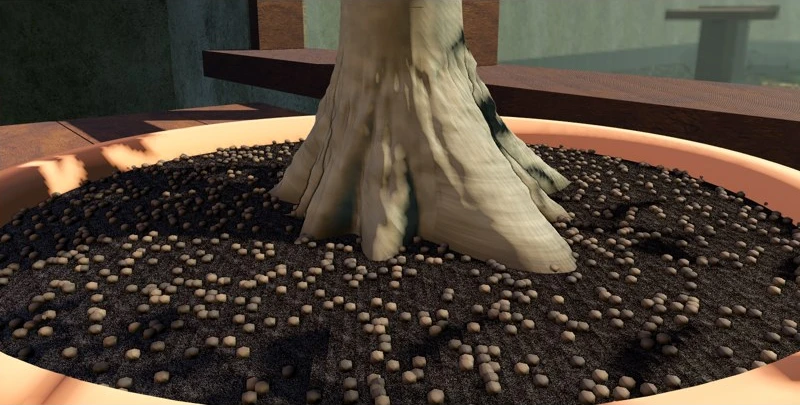
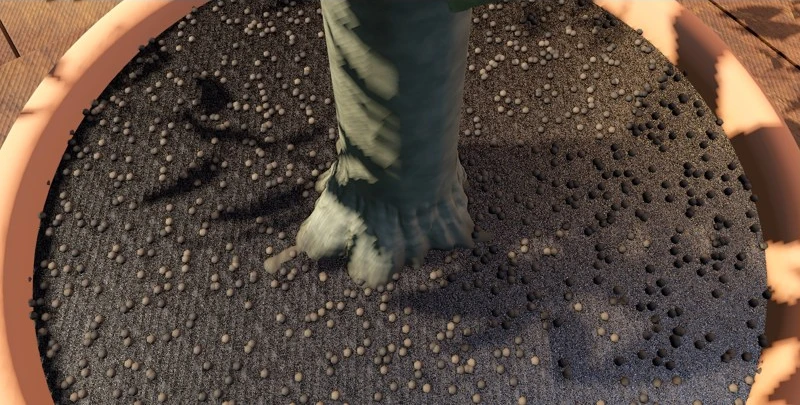
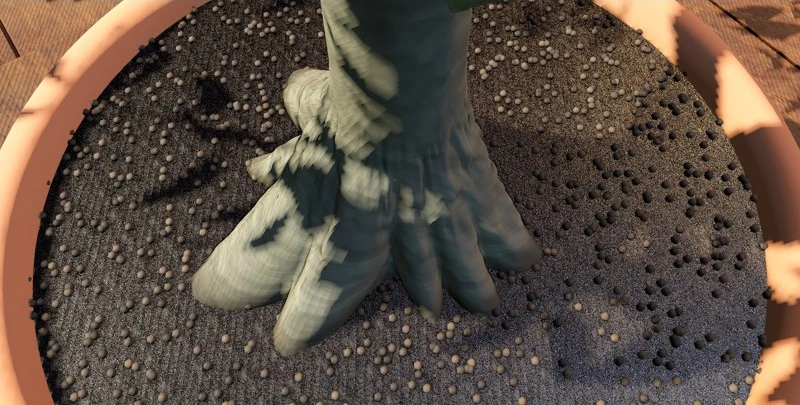
The repot panel got a Roots section to go with it: a note on what the roots are doing, and three buttons, Comb outward, Cut a diving root and Lower the soil. Each species' Shaping page now explains how its base is built. This is on a branch for now, together with the new root flare, where the lower trunk widens into lobes rebuilt from photographs of real trunk bases.
Lift it and look
The lifted ball shows the diving roots, so you can see the fault before you cut it.
Mist a ficus and it grows roots in the air
Misting is here, and I made it almost impossible to get wrong. Tap F for a spray over the whole tree, or hold it for a spray a second, and three sprays make a full misting. Keep a ficus misted at the bench for about four weeks and it starts aerial roots. They hang from the undersides of the trunk and the older wood, lengthen while the air stays humid, reach the soil and thicken there, paid for from the tree's own carbon. Stop misting and the hanging ones dry and die in about two weeks, while the grounded ones live on. The ones against the trunk widen its flare, which is how a real fig builds that broad, rooty base.
Shaded inner leaves now fall after about a season on every species, judged against the crown's own top. Both are on a branch, and its checks pass.
A young ficus that grows like one
I grew a fresh ficus for a year and it looked spindly, nothing like a real fig at that age. So young trees now grow their own leaves: bigger leaves on a tree with few shoots, shrinking as it ramifies, and a ficus leaf lives about 540 days. Kept buds break again after a clip, and a ficus in development thins its crowded crown each June, cutting the weakest twigs until it sits at 70 % of its organ room. It's on its own branch while I compare it against photographs of real young figs.
What's next
- Root work and the root flare: a final look, then merge.
- Misting and aerial roots: decide on the merge.
- The young ficus: check it against real young figs at one, three and five years.
- Cherry leaves with fine serrated edges and a warmer light under the exhibit trunk, both on branches.
- Frame-rate checks for the denser soil and the new leaf edges on the development PC.
What I learned
Look below the trunk. Half of what makes a bonsai read as old is where it meets the soil, and both the soil and the base had been faked with pictures. Building them from the same model as the tree made them answer to care like everything else.
Sources & development context
Based on House of Bonsai's source history from 2 to 5 November: the soil-mix merge to main (3 November), the root-work and root-flare branches (2 to 3 November), the ficus aerial-roots and misting branch (2 November), the young-ficus branch (4 November) and the root-work before and after renders.